Monday, September 24, 2012

Wild Berries: contrast between subject and background

A brief time spent with some wild berries in the middle of the "mosquito patch", and how to "change the background"...without changing the background:

This wild fruit ripened in an area that was unfortunately overrun by flying hexapodal syringes (a.k.a. skeeters). There were a few pretty specimens hanging in various locations on the shrub, but the background was going to be a challenge. There were all sorts of ugly broken branches, dead leaves, etc., and the patches of direct sunlight coming through small openings in the tree canopy made a hodgepodge that was not going to photograph in an attractive fashion. My most successful shot from a "graphical" perspective took shape when I found one berry in a narrow shaft of sunlight. Getting close, and exposing for the subject, I was able to get the background to go black and disappear. This left me with the stark shapes of the fruit, leaves, and stems, with nothing else to distract. Well, there is a bit of spider silk caught by the edge of the light in the upper right. I like that, though, and consider it a minor balancing element, rather than a distraction.


I did want to try to portray more of the context, and moved about on the ground until I could no longer bear the assault of the biting bugs (in spite of deet, I might add). This next shot was a pretty good idea, I think, but not completely successful because of the overly bright highlights in the background. I just needed an assistant to hold up a scrim or a flag and block the intense sun from that area! I tried lower angles to show different shapes of the subject, but the sky was bright and colorless, so not much luck.


A closer view works a little better in some ways:


All shot with the very flexible Canon 100/2.8 L macro lens. It's great for portraits of people, animals, berries, and insects!

Permalink: http://jilcp.blogspot.com/2012/09/wild-berries-contrast-between-subject.html

Autumn Debris

We're a few days into autumn in the northern hemisphere, but it will be several weeks before I would expect to see advanced fall colors in the trees of the North Carolina piedmont. Still, the little taste of cooler temperatures that we've gotten has me already very much in the mood for the sights of seasonal change. I'll use that as my excuse for focusing on a dying leaf. Actually, this one was hanging on to survival, but suffered as a victim of insect munching.


To emphasize the jagged lines and bring out the contrast of the holes, I added some light from a flash left of camera (a Canon 600EX-RT, triggered by ST-E3 radio), dialed back to about half the strength of the ambient daylight.

In Adobe Lightroom, I converted the image to black and white, then split-toned for warm brown shadows and coolish yellow-green highlights.

Permalink: http://jilcp.blogspot.com/2012/09/autumn-debris.html

Thursday, September 20, 2012

visual parallels, odd juxtapositions, odd image processing

Sometimes I see visual parallels in things that might strike you as unrelated. A drooping basketball backboard and the drooping tree branches behind it. A "straightforward" rendition of this take didn't convey what I felt when I shot it, so I "cooked things" just a little in Adobe Lightroom and Photoshop. Here's the straight shot:


Here's what I came up with in a few minutes of fiddling. It's much more like what I "saw", i.e., what went through my mind as I tripped the shutter.


If you're curious, basically I increased contrast by a few different methods (contrast and clarity in Lightroom, partially masked "multiply" layer in Photoshop), allowing some of the shadows to go black. This is similar to what I might have gotten years ago by shooting Fuji Velvia slide film, under exposing to maximize saturation and highlight detail, and "cooking" the print a bit (mostly by filtration) to optimize the results.

To me, the dark shadow under the tree and the contrast of the drooping branch fit with the falling-down backboard and its scratched and worn surface. Gritty suburban disrepair? An overblown interpretation if taken literally, but maybe enjoyable if taken lightly.

Permalink: http://jilcp.blogspot.com/2012/09/visual-parallels-odd-juxtapositions-odd.html

Renewed by the Rain

September 16, 2012
Sometimes it doesn't seem possible to even catch a glimpse of new flowers before they have been partially eaten by insects. I'd rather manage a photograph of one perfect wildflower than buy a bouquet of immaculate blooms from a florist. It's not that I mind buying cultivated flowers once in a while, not at all. I suppose it's just a part of the hunt for perfection, hoping to find something for myself, even if I played no role in its being there.

Well, today even the latest, another batch that just opened yesterday, are somewhat chewed up around the edges. The good news is, the morning rain left them looking sprightly, in spite of their imperfections. Out came the camera...


Jess Isaiah Levin
Permalink: http://jilcp.blogspot.com/2012/09/renewed-by-rain.html

Wednesday, September 12, 2012

Close Encounters of the Insectoid Kind

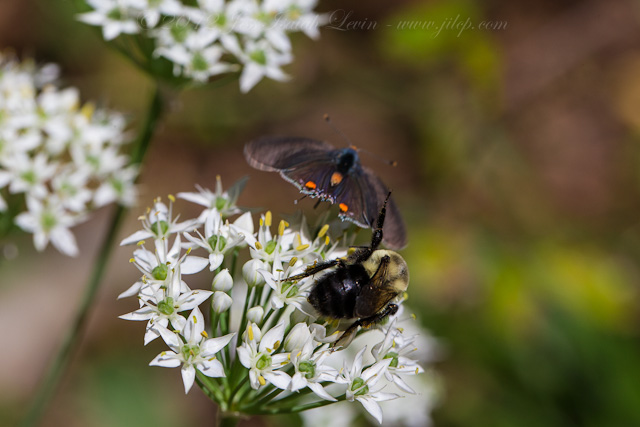
Sometimes watching a single bed of wildflowers for a short while can make me feel as if I'm in Grand Central Station. In my latest session at knee level, I spotted a color-coordinated visitor.


The bees really like the onion blossoms. They move constantly, so a fast shutter speed is necessary to stop the action. (All of these photos were done with just the existing daylight, no flash, no reflectors.)


Flies visited the same flower patch at the same time. This is, I think, a bottle fly.


The butterfly landed first, and I was photographing it when the bee landed. I expected the butterfly to leave, but it stayed pretty much in one place while the bee wandered around. I was hoping I could catch a close encounter like this, and managed it at last. Note the considerable load of pollen on the bee's leg. I laughed when I enlarged this shot on the computer monitor and noticed how the butterfly's curled tongue had formed a smiley face against the yellow anther behind it.


Okay, that's enough sharing my space - ciao! Butterfly in flight!


"Quickly as you can, snatch the pebble pollen from my hand!" (Kung Fu TV show reference, for those old enough to notice.)


Some closer views of the bottle fly.


And I stood up for an Eastern Tiger Swallowtail (which may have been attacked, judging by the damage to its tail). It seemed to be doing fine, and was certainly still beautiful against the trees and sky.


I've learned that even if I only have twenty or thirty minutes to spare, I can get in some good lens practice, and even learn a little bit about the creatures which surround me. I've always been inclined to notice them, but I can see so much more with the aid of a camera!

Permalink: http://jilcp.blogspot.com/2012/09/close-encounters-of-insectoid-kind.html

Sunday, September 9, 2012

More obsession: watching wildflowers develop

I like watching time-lapse videos of flowers opening, eggs hatching, stars wheeling as the Earth rotates. I personally enjoy creating series of still photos that show development from differing perspectives. When some wild onion flowers were just beginning to bud, I started watching them. The first photos that I liked were when they were partway open.


When they flowered, I tried to show them both in context and in isolation.


When some bees became interested, I knew the flowers were near their peak, and it piqued my interest in catching them in the act. Iridescence and sunlight! Yay!


The bumblebees let me get really close.


I almost thought I was about to witness a confrontation between species, but the little guy was allowed to share in the nectar.


Permalink: http://jilcp.blogspot.com/2012/09/more-obsession-watching-wildflowers.html

Saturday, September 8, 2012

Chasing the sky

A week ago, I was out running errands when the clouds began to develop such a fascinating mix of different types that I felt compelled to get to a spot where I had a clear view of the sky. I was determined to make a photo of some subject - any subject - that would be complemented by what was above and around. Failing that, I figured I should at least document the crazy shapes in the sky.

I got to an area on the outskirts of town, where there is a view down close to the level of the horizon in most directions, albeit with power lines and other things not usually thought to be photogenic. I found a bike path that looks much like a country lane. I set up a composition with the electrical lines on the left kind of mirroring the wire fence on the right. I also liked the way the clouds fit in with the receding perspective of the road and the trees on the right. It really was amazing watching all the layers of different cloud types sliding over and under each other. I was enjoying everything, but also trying to keep my mind on getting the shot before it disappeared.


I grabbed one of the sky alone, figuring that I could possibly add it to a new landscape some future day (Photoshop is easier than darkroom multi-printing!), but I rather like it by itself.


Nearby, this little urban pastoral scene intrigued me even though some of the incredible sky was hidden by the tree.


Permalink: http://jilcp.blogspot.com/2012/09/chasing-sky.html

Friday, September 7, 2012

Keep those eyes open

I've often suggested that we can see interesting things almost anywhere, anytime, if we practice looking with "fresh eyes." A corollary notion is that when you set out to photograph something in particular, it's a good idea to be open to other treatments than the one you planned, and even to other subjects that you were not looking for. As an example, in the middle of one of the child portrait sessions that I did recently, we came upon a colorful spider. I couldn't take the time to mount a macro lens (in fact, I didn't have one in my bag that day). Checking the exif info for the sequence of photos, I see that I only interrupted the stream of shots of the toddler subject for about 20 seconds to get this photo of the spider. I was doing everything with a fixed focal length, a fast 50 mm. It was not possible to get a frame filling, detailed shot of the arachnid, but I like this environmental composition. Here it is, with its web visibly spanning the leaves, an ordinary picket fence in the background, and look at the characteristic zigzag pattern through the center of the web! I thought it was well worth shooting.


During the same shoot, in the same area, I spotted this flower separated from the plants around it. Again, although the "normal" lens wouldn't give the kind of high impact close up that a macro would, it made a nice atmosphere and did a good job of blurring the background into vaguely suggestive shapes, thanks to an f/1.2 aperture.


Both of these images are compositionally a little unusual for me. I almost never place the main subject right in the middle of the frame, but...sometimes I think it works. Now here's a serendipitous visitor that I snagged in the same shoot, actually about a minute and a half before spotting the spider:


Yet again, I like having the tools to get up close and personal with bugs, but sometimes a broader view is enjoyable. And in spite of what you might imagine, my overall focus was on the child, and we got many, many photos that I'm sure will not only be enjoyed by her parents, but also by her, when she is a bit older.

Permalink: http://jilcp.blogspot.com/2012/09/keep-those-eyes-open.html

Thursday, September 6, 2012

How and when do we become camera aware?

If you are of sufficient age and worldly awareness, you probably realize that not so long ago, there were places where many people had little if any daily interaction with cameras. Now, in a world with almost 6 billion cell phones, and most cell phones incorporating a camera of sorts, you have to really travel far afield and hunt to find someone who has never been photographed (or even, never been aware that they have been photographed, unless we're talking about infants).

I've always liked to capture the kind of natural expressions that people display when they are not thinking about being photographed, even if they are quite aware at some level that a camera is being used in the area. On the other hand, there are some people who are just "naturals" in front of a camera. We've read about actors and actresses who are "loved by the camera", who apparently always look great with minimal effort on the part of the director and cinematographer. Then of course there is the art of acting itself, which entails, among other things, looking the part. However, in my little world I interact mostly with "ordinary people", and yet it strikes me that some of them have a great natural ability to be themselves and let all their personality show, at the same time that they are quite aware that they are being captured in photographs. The amazing thing is that sometimes you see this in two and three year old children. I suspect it may be a little more common than it was when I was a child, simply because kids grow up surrounded by cameras, and because they are now digital, parents or other photographers can say "do you want to see yourself?" and immediately show the image to the child. None of that takes away any of my wonder when I get the chance to work with a young customer (well, of course the parents are the customers) who is so at ease in front of the lens.


Even so, I'd say it's hard to deny that catching the very young ones when they get caught up in play, and are not doing any "acting" for the camera, is one of the best ways to turn simple moments into keepsakes.


And then sometimes you get surprised and rewarded by a smile and eye contact!


Permalink: http://jilcp.blogspot.com/2012/09/how-and-when-do-we-become-camera-aware.html

Hydrangea, to celebrate the return

To celebrate the return of an internet connection to my photo studio (after a lapse of almost a week) I will pretend that I hardly missed it. Ha! How easy it is to become dependent, and even more so, to feel dependent. Nevertheless, here is a photo from more than two months ago. The vast majority of the images I post in this blog are up quickly, and are as much for me to take stock of what I've done in the past day or few as they are for others to see. But I did say celebrate, so here's a hydrangea that I admired this past spring. Blue may not seem like a celebratory color, in isolation, but strong color contrast is almost always a part of festival and holiday decorations. Primary colors in juxtaposition are usually eye catching, but I particularly like including delicate color transitions and textures in a picture of this sort. Some beautiful flowers hold a sort of cold attraction, making you want to smell them, but not touch. This hydrangea, seen up close, had an almost pansy-like richness of texture, so I tried to capture some of that feel in the photo.


Permalink: http://jilcp.blogspot.com/2012/09/hydrangea-to-celebrate-return.html