Saturday, June 28, 2014

One day, two photo walks

A stroll through just one corner of the Raulston Arboretum can take you from a taste of Southwestern Desert to Southeastern Tropics.


The Arboretum is not all that far from downtown Raleigh. The grounds of the Dorothea Dix Hospital Campus are even closer to the heart of the city. From high ground, the gaps in the trees allow this view to the Wells Fargo and PNC towers.


Otherwise, the surroundings are peaceful and beautiful. I hope that most of the remaining land will be set aside for use as a public park. What a prize that would be for the city's residents, and what a good influence on the continued cultural development of Raleigh!


I became intrigued by one tree, and played with it photographically.


Which way is up?!


The sky was conducive to framing some of the empty buildings as an architectural landscape.


Permalink: http://jilcp.blogspot.com/2014/06/one-day-two-photo-walks.html

Wednesday, June 25, 2014

Hand-held street shooting - with a tilt/shift lens?

Sometimes a "specialty" lens is not ideal for a casual walkabout in search of photos of local color. On the other hand, it can suggest interesting approaches. As a challenge to myself, I wandered with my 17mm TS-E (designed to allow tilt and shift for perspective and focus plane adjustments), and without a tripod.

Using the maximum amount of upward shift, I could keep the camera perfectly level, shoot from the street, and still show plenty of sky above the Second Empire tower of the Dodd-Hinsdale House, built in 1879 and now the home of the restaurant taking the name of its architectural style.


Not far away is a hotel that's a familiar sight to anyone living in the area.  A slight upward tilt of the camera, with the same lens shift set up as the previous photo, gave me the framing I wanted and let me show a little vignette of summer relaxation on this very warm day.


I short trip in the car brought me to a favorite pastoral setting where I could walk amid rather different surroundings. When I spotted this insect perched atop the thistle, I wished I'd brought a macro lens, but I really was trying to do a minimalist photo trek. I got as close as I could with the 17mm, and cropped the image later.


I had tossed a very compact and light 40mm "pancake" lens in my bag, and used that for a different view of the scene. I like the dreamy quality that resulted.


Permalink: http://jilcp.blogspot.com/2014/06/hand-held-street-shooting-with.html

Monday, June 23, 2014

Success is all in how you look at it...

I wandered to a quartet of lakes and ponds in different areas of Raleigh Sunday, spotting little wildlife and netting zero images of interest from the first two. I did have fun with some outdoor sculpture at the NC Museum of Art. It was a drizzly morning, but the low contrast light was attractive.

Birds imitate art:


Wild-art-life:


No luck at the museum pond this time. Off to Lake Raleigh, then, but there was a race going on. So, onward to Lake Johnson. Life imitates art:


A more serene view:


To the fourth watery area I visited in the day, but no birds or other wildlife, only some static reflections.


Drowning tree:


The mud was deep and viscous. It tried to steal my shoes. If algae could experience contentment, this would be it:


It was a day of mixed results, but I also got in some useful scouting for future adventures.

Permalink: http://jilcp.blogspot.com/2014/06/success-is-all-in-how-you-look-at-it.html

Wednesday, June 18, 2014

flowers imitating insects

Flowers have evolved many features to lure insects which promote pollination. There are nectars that provide food for bees, colors that are attractive (and sometimes have bold patterns that only stand out for creatures with vision that extends into the ultraviolet range), and perhaps most transparent to a human observer, flower parts that mimic the appearance of live insects.

In some cases, insects are repeatedly observed to attempt to mate with a flower. The masquerading features are strategically located near the flower's actual sexual organs, so the innocent insect almost inevitably picks up pollen, or deposits it where it needs to be for the plant's reproduction.

The flowers that I spotted in the heat this afternoon probably don't quite fit that last scenario, but reminded me of these strategies because to my own eyes there was a very nice simulation of an odd five legged beast just sitting patiently in the center of the petals...


Permalink: http://jilcp.blogspot.com/2014/06/flowers-imitating-insects.html

Sunday, June 15, 2014

African violet

Timing and light...I found an African violet that had just opened!

Larger than usual photo below the "Fib"...*

-

-

- -

- - -

- - - - -

- - - - - - - -

- - - - - - - - - - - - -

- - - - - - - - - - - - - - - - - - - - -

- - - - - - - - - - - - - - - - - - - - - - - - - - - - - - - - - -

- - - - - - - - - - - - - - - - - - - - - - - - - - - - - - - - - - - - - - - - - - - - - - - - - - - - - - -

* The Fibonacci sequence seemed appropriate for a spacer above a flower image.


Permalink: http://jilcp.blogspot.com/2014/06/african-violet.html

Friday, June 13, 2014

Wet bird in the yard

Not a convict in the pen.


[@600 mm, heavily cropped from 18MP original to ~2.5MP, shot at ISO 16,000!]

I don't miss the days when color negative film at ISO 1600 was pretty much the usability limit, and was much grainier, less sharp, and poorer in color rendition than my Canon 1DX set for 3.3 stops greater sensitivity. A camera can represent a very large investment, but my film and processing costs are much lower now, and I spend no more time processing in Adobe Lightroom than I used to spend in my primarily black and white darkroom. Which is a lot of time, I must admit...

Pernalink: http://jilcp.blogspot.com/2014/06/wet-bird-in-yard.html

Monday, June 9, 2014

Portraits and grab shots at 600 mm

Once again I set out walking with a 600 mm lens (actually 300 mm with 2X extender attached) in hopes of spotting some birds in flight within range of my "reach". As sometimes happens, my timing was bad and every heron, black bird, vulture and pigeon in the area must have been napping in the shade.

This was a good enough excuse to approach an unafraid duck resting under a pedestrian bridge, who let me creep up to a distance of about 7 or 8 feet. Hey, that's an interesting profile, could we do a portrait/head shot session?


How about if you turn and give me a three quarter view?


The light's a little tricky...would you show me your other profile? Oh, I like that one the best!


I walked to a different part of the shore, expecting to have it to myself and see what floated by. To my surprise, a family was there with a cardboard box. The box turned out to contain a pair of white ducks. Before I could even think about changing lenses, the box was on its side and the contents emerged. I backpedaled fast to get far enough away to grab this shot with my 600.


I asked about the circumstances and learned that the two had been rescued and rehabilitated. Once released, they seemed content to just stay on the shore near their adoptive family, so the father picked them up and put them in the water. Moments later, they were apparently happy to be back in their home medium.


One came back to the shore briefly to say all was okay.


Some friends:


Permalink: http://jilcp.blogspot.com/2014/06/portraits-and-grab-shots-at-600-mm.html

Tuesday, June 3, 2014

Plants and Equines in overhead sun

Monday afternoon was, photographically, a kind of exercise in finding subjects that worked in "boring" overhead sunlight. Not a good time for (human) portraits in natural light, but not bad for everything. I found some wildflowers and plants that did well with the contrasty sun.


This clutch of trees leans so heavily with the lack of support from the swampy ground that I find it visually amazing that they still stand.


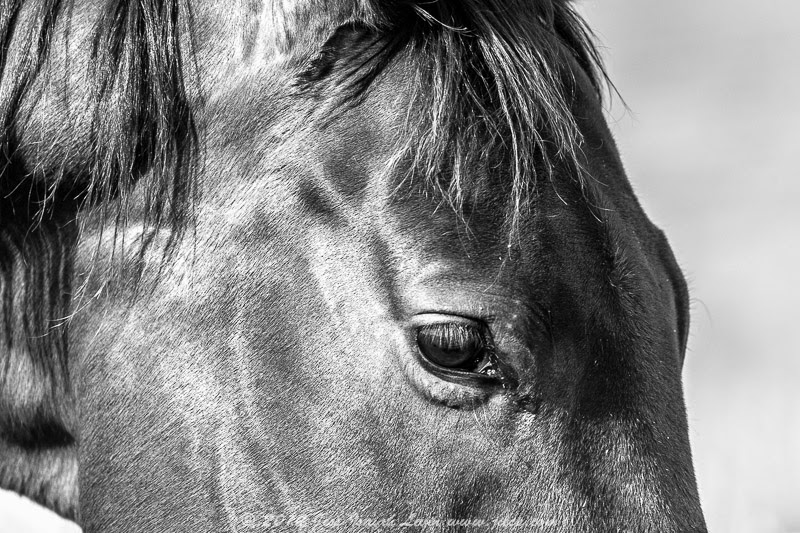
I emphasized the creases in this horse's skin by zooming as close as I could and using a high contrast development to amplify what the sun had shown me. I hope he doesn't follow this blog!


Here's a chance to examine dentition.


It's interesting how their musculature is defined when they twist and turn.


Is that a swift? With my left eye I saw a blur approaching (I often keep both eyes open when shooting, because of situations like this), and snapped while it was in the frame. Because of focal length and aperture, it's a blur in the photo too; couldn't be helped.


The flies were swarming brutally, and made me feel sorry for the horses. You can even see some of them in these web-sized images, mostly against plain backgrounds like the sky. No, that is not dust on the sensor!


My, what whiskers!


This was one of the largest dandelions gone to seed that I've ever seen. It dwarfed the clover.


[All photos with Canon EF 100-400 L IS]

Permalink: http://jilcp.blogspot.com/2014/06/plants-and-equines-in-overhead-sun.html

Sunday, June 1, 2014

Lacewing Larval Disguise

A ball of pollen-like fluff about 1/8 inch in diameter was moving around on our glass door. It looked like this:
 

If not for the rapid sliding and rotating movement, I would have thought it was just a bit of detritus stuck amongst the inevitable dust. However, the other side looked like this (at high magnification, greater than life size on the camera sensor, cropped to get closer still, and many times life size on your computer monitor):


A little internet searching revealed that it is the larval stage of a common variety of Lacewing. Many of them carry a backpack of fibers like this; my guess is that it's a camouflage against predators. This one was quite systematically scouring the glass surface for tinier things to eat. I will have to make a point of photographing some adult Lacewings this summer.

[Canon EF 100mm f/2.8 L IS macro, 37mm of extension tubes, remote flash]

Permalink: http://jilcp.blogspot.com/2014/06/lacewing-larval-disguise.html